 |
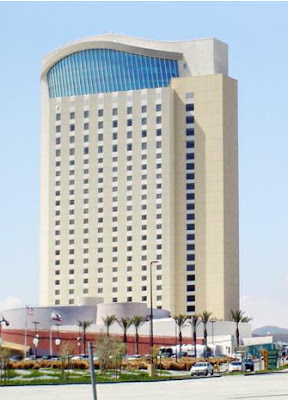
Morongo Hotel and Spa, Cabazon, CA (actually in the desert) |
This is not an advertisement advocating the benefits of the desert casino and spa. On the contrary, on our drive from Tallahassee, FL to Stanford, CA, this building was the most monstrous sight we encountered. In terms of the landscape as text--the thread of this and the previous blog--this hideous spectacle might be read as an attempt to conquer the desert that is ultimately testimony to the human's capacity to spoil. It's much more complicated than this, though, since the Morongo band of Native Americans, whose land this is, are the owners of this casino resort. In addition, the construction company claims the resort was 'inspired by the forces of nature and is intended to bring a piece of paradise to the desert' (http://california.construction.com/projects/04_BestOf/casino_morongo.asp). Still, reminiscent of ancient monsters, many of whose characteristics reappear through the imagination of Russell T. Davies in Dr Who and other sci-fi series, from the I-10 road, this hotel bestrides its desert setting like a concrete cyclops, or better still, medieval Blemmyae.

 |
Blemmyae from British Library manuscripts (see http://www.bl.uk/learning/histcitizen/medieval/monsters/medievalmonsters.html) |
Blemmyae, acephalous monsters with their faces on their chests, were strange and frightening, living with other alien creatures in distant lands. In the Old English Wonders of the East in London, British Library, Cotton Vitellius A. xv (the Beowulf-manuscript), these chest-faced beings are said to be eight feet tall and eight feet wide and living on an island with dragons that are 150 feet long. These overlarge monsters, dominating their landscape, are the stuff of fantasy--until one comes across the Morongo reality on the I-10, near Palm Springs.
One can hardly talk about medieval monsters without reference to Jeffrey Jerome Cohen's 'Monster Culture (Seven Theses)', published in Monster Theory: Reading Culture, ed. Jeffrey Jerome Cohen (University of Minnesota Press, 1996), 3-25. He comments that 'The habitations of the monsters (Africa, Scandinavia, America, Venus, the Delta Quadrant--whatever land is sufficiently distant to be exoticized) are more than dark regions of uncertain danger: they are also realms of happy fantasy, horizons of liberation'. In the case of Morongo, it seems that a place of uncertainty--the desert--is transformed into a locus amoenus, a pleasant place, by the construction of the monstrous: a huge watch-tower with its glass eye guarding over the landscape, attempting, perhaps, to suppress, tame it, change its inhospitable nature. I find the one-eyed building sinister and ineffably ugly, but it brings money to the Reservation, allowing the Morongo band of Native Americans to make viable economic use of the parcel of land they were left with.
And yet.
Yet, in a larger sense, Casino Morongo fails to dominate. It's certainly startling as it rears up on the side of the I-10 (rightly winning the I-10 journey prize of 'most hideous'); but, as the photograph taken by Roy Randall on Flickr so ably demonstrates, this concrete carbuncle is nothing in comparison to the landscape it seeks to cultivate:
 | |||
| Casino Morongo from the mountains (http://www.flickr.com/photos/zeroy/2977965265/) |
From a distance, the Casino becomes a speck, just another trace of passers-through. From this distance, the Casino Hotel is little more obvious, indeed, than the petroglyphs, carved millennia ago, in the Coyote Hole rocks near Joshua Tree, earlier marks left by those for whom this wilderness was home.

